

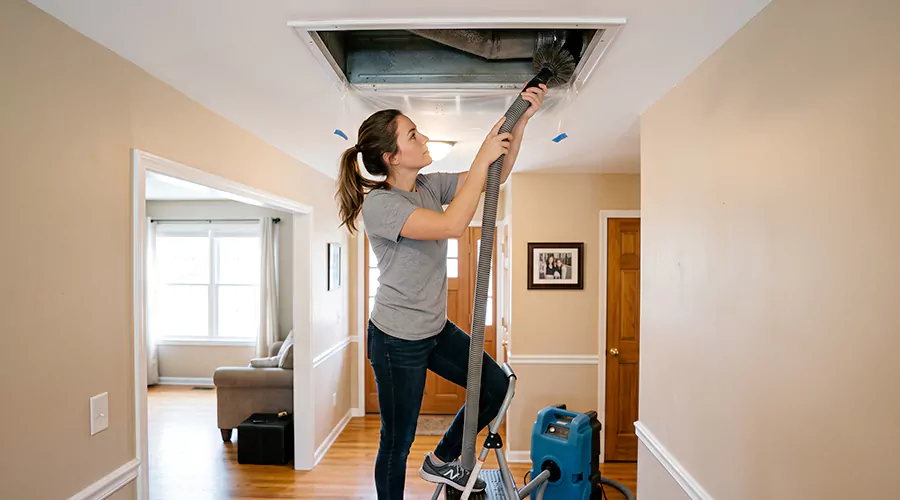
Air duct cleaning typically costs $0.15 to $0.40 per square foot of home size in the United States in 2026, depending on the contractor's pricing method. For a 2,000-square-foot house, that works out to approximately $300 to $800 before any minimum service charges or additional work. However, many companies quote a flat price for the entire HVAC system instead of charging strictly by square footage.
Air duct cleaning involves removing accumulated dust and debris from the air distribution system. The work may include supply ducts, return passages, registers, and other affected HVAC components. Larger homes often contain more ductwork and vents, which can increase the time required for cleaning. Home air duct cleaning helps address this buildup throughout the home's ventilation system.
Square-foot pricing provides a useful way to estimate the potential expense before contacting a contractor. However, a home's floor area does not directly measure the length or complexity of its duct system. Two houses of the same size can receive different quotes because they have different equipment configurations, duct materials, or access requirements.
Understanding how square-foot pricing works helps homeowners develop a realistic budget and compare estimates. It also makes it easier to identify charges that are not included in the advertised rate.
What Is the Average Air Duct Cleaning Cost per Square Foot in 2026?
Published 2026 U.S. pricing guides show two commonly used square-foot ranges. Angi reports approximately $0.15 to $0.30 per square foot, while HomeGuide lists approximately $0.20 to $0.40 per square foot. Together, these estimates provide a broad planning range of $0.15 to $0.40 for residential projects.
These figures are pricing benchmarks rather than fixed nationwide rates. A contractor may quote a higher or lower amount depending on local labor costs and the condition of the system. Some companies also apply minimum charges, particularly for smaller properties where the calculated square-foot amount would not cover setup and cleaning labor.
| Pricing Reference | Estimated Cost per Square Foot |
|---|---|
| Angi's 2026 range | 0.15–0.30 |
| HomeGuide's range | 0.20–0.40 |
| Combined planning range | 0.15–0.40 |
Square-foot prices should not automatically be added to per-vent charges. These are usually alternative methods for calculating the same cleaning service. The contractor should explain which pricing method applies to the proposal.
The quoted rate should also identify whether it covers the supply and return ductwork or includes additional HVAC components. A lower square-foot rate may provide less work than a higher quote covering the complete system.
How Much Does Air Duct Cleaning Cost by Home Size?
Home size is a useful starting point because larger properties often have more rooms and supply registers. As the duct network expands, technicians may need to clean additional branches and main passages. The following table uses the published HomeGuide range of $0.20 to $0.40 per square foot.
| Home Size | Estimated Cleaning Cost |
|---|---|
| 800 square feet | 160–320 |
| 1,000 square feet | 200–400 |
| 1,200 square feet | 240–480 |
| 1,500 square feet | 300–600 |
| 1,800 square feet | 360–720 |
| 2,000 square feet | 400–800 |
| 2,500 square feet | 500–1,000 |
| 3,000 square feet | 600–1,200 |
| 3,500 square feet | 700–1,400 |
| 4,000 square feet | 800–1,600 |
These estimates are mathematical examples rather than guaranteed prices. The total may be affected by a company's minimum charge or a flat-rate whole-system package. A 1,000-square-foot apartment with difficult duct access can also cost more than a larger property with one straightforward HVAC system.
The table assumes that the entire floor area is used for the calculation. Some contractors may price according to a different service area or inspect the actual duct network before providing a final estimate. Confirm how the square footage is measured when comparing proposals.
How Do You Calculate Air Duct Cleaning Cost per Square Foot?
The basic calculation is straightforward. Multiply the home's square footage by the contractor's quoted rate. The resulting amount is an initial estimate for the cleaning project, assuming the rate covers the intended work.
Air duct cleaning cost = Home square footage × Cleaning rate per square foot
For example, a 2,000-square-foot home using a cleaning rate of $0.25 per square foot would have an estimated price of $500. At $0.35 per square foot, the same home would have an estimated price of $700. The difference comes from the quoted rate rather than the size of the property.
An online calculation does not always represent the final invoice. A contractor may discover that the home contains two independent HVAC systems or unusually difficult-to-reach ducts. The written quote should identify those circumstances before additional charges are approved.
Example Calculation for a 1,500-Square-Foot House
At $0.20 per square foot, a 1,500-square-foot home would have an estimated duct cleaning cost of $300. At $0.40 per square foot, the calculated amount would be $600. This provides a useful initial range before the duct layout has been inspected.
The actual cost may fall outside the range if the contractor charges a minimum fee or the home contains significant contamination. A property with multiple systems can also require additional setup. These factors should be considered separately from the floor-area calculation.
Example Calculation for a 2,500-Square-Foot House
At $0.20 per square foot, a 2,500-square-foot home would cost approximately $500 to clean. At $0.40 per square foot, the estimate increases to $1,000. The difference may reflect local market conditions or a more extensive cleaning scope.
Before choosing a contractor, ask whether the supply and return ducts are included. A whole-system cleaning should not be confused with a service that only cleans accessible grilles. The cleaning method and components covered matter as much as the calculated amount.
Why Do Air Duct Cleaning Prices Vary Between Homes?
Square footage provides an approximate measure of property size, but it does not describe the entire HVAC installation. A house may contain one central system or several smaller systems serving different areas. The number of returns, duct materials, and access conditions all influence how much cleaning work is required.
Number of HVAC Systems
A single HVAC system generally requires one primary cleaning setup. A home with separate upstairs and downstairs systems may need two setups because the duct networks are independent. This can increase labor even when the house has the same floor area as another property.
The contractor should identify every system included in the estimate. A quote covering one air handler does not necessarily include a second furnace or separate cooling unit. Confirming the equipment count prevents incomplete cleaning and unexpected charges.
Number of Supply and Return Vents
Supply vents deliver conditioned air into rooms, while return openings carry indoor air back toward the equipment. Each connected branch may require separate access during cleaning. A larger vent count can therefore increase the amount of work.
However, vent count does not always increase directly with square footage. A large open-plan room may contain fewer branches than several small rooms occupying the same area. Some contractors use per-vent pricing because they consider this a better measure of the cleaning scope.
Type of Duct Material
Rigid sheet metal ducts and flexible ductwork require different cleaning methods. Sound metal passages may support controlled mechanical agitation, while thin flexible liners require gentler techniques to prevent tearing. Fiberglass duct board and internally lined ducts also need material-specific handling.
The type of ductwork matters because aggressive cleaning can create damage that did not exist before the service. A contractor should inspect the materials before selecting equipment. Severely deteriorated or contaminated insulation may require replacement instead of ordinary cleaning.
Accessibility of the Ductwork
Ducts in an unfinished basement may be easier to reach than passages concealed behind finished walls. Some installations have existing access points, while others require temporary openings for proper cleaning. Creating and restoring those openings can add labor.
The quote should explain whether access work is included. A company that cleans only through registers may not be able to reach every component of a complicated duct system. Homeowners should understand how the contractor plans to clean the full agreed area.
Amount and Type of Contamination
Ordinary dust deposits are different from extensive construction debris or pest contamination. Significant buildup may take more time to loosen and collect. Some conditions also require another service before cleaning can proceed safely.
For example, evidence of pest activity may require removal of the infestation and correction of entry points. Suspected mold associated with water damage may require moisture correction and material assessment. These situations should not automatically be treated as standard dust-cleaning projects.
Local Labor Rates
Professional cleaning rates vary between cities because of differences in wages and business operating costs. Contractors may also use different equipment and crew sizes. A higher local price does not necessarily mean the system contains more contamination.
The best comparison is a set of written estimates based on the same work. Ask each contractor to describe the number of systems and components included. This helps distinguish real scope differences from pricing differences.
Is Square-Foot Pricing Better Than Per-Vent Pricing?
Neither pricing method is automatically more accurate for every property. Square-foot pricing estimates work using home size, while per-vent pricing considers the number of visible openings connected to the system. A flat-rate quote may be based on an inspection of the complete duct layout.
Published 2026 pricing estimates commonly place supply-vent cleaning at $25 to $50 per opening. Return vents may be priced higher, around $40 to $75 each, when contractors distinguish between the two. These amounts may produce a different total than a square-foot calculation.
| Pricing Method | Common Estimate | Main Advantage |
|---|---|---|
| Per square foot | 0.15–0.40 | Simple initial estimate based on property size |
| Per supply vent | 25–50 | Reflects number of branch openings |
| Per return vent | 40–75 | Separately accounts for return cleaning |
| Flat whole-system quote | Varies with system and scope | Can define the complete project upfront |
A 2,000-square-foot house with ten supply vents and two returns could receive different totals under these methods. That does not automatically mean one contractor is overcharging. The price may also depend on whether the main ducts, blower, and other relevant components are included.
Do not combine pricing methods unless a contractor clearly identifies separate work. Charging by square footage and then adding an unexplained fee for every vent may lead to double-counting. A written estimate should make the final total understandable.
What Is Included in the Air Duct Cleaning Price?
A professional duct cleaning project should have a defined scope based on the condition of the HVAC system. Commonly addressed components include supply and return ducts and their registers. Depending on the agreement, relevant plenums and other HVAC components may also be inspected or cleaned.
A source-removal cleaning method uses suitable agitation equipment to loosen deposited material while a vacuum collection system captures it. The contractor should prevent disturbed debris from entering occupied rooms. The system's duct materials determine which brushes or other tools can be used safely.
| Component | Should It Be Addressed? |
|---|---|
| Supply duct branches | When included in the agreed cleaning scope |
| Return duct passages | When included in the agreed cleaning scope |
| Register covers and grilles | Commonly cleaned |
| Main duct trunks | Should be considered in whole-system cleaning |
| Supply and return plenums | Include when affected and within scope |
| Blower assembly | Check whether equipment cleaning is included |
| Cooling coil and drain pan | Inspect and service as appropriate |
| HVAC filter | Inspect and replace if needed |
A contractor should not advertise complete-system cleaning while quietly excluding major affected components. The Environmental Protection Agency advises that contaminated systems should be cleaned appropriately as a whole to avoid recontamination. The exact work must still reflect the material condition and reason for cleaning.
The price should also account for restoring any temporary access openings. These openings must remain securely attached and airtight after the work. A cleaning project should not create new duct leakage.
What Additional Charges Can Increase the Final Cost?
Some contractors offer inspection and equipment services separately from ordinary duct cleaning. These may be useful when an actual problem has been identified, but they are not automatically necessary for every home. A detailed quote should distinguish required work from optional services.
Possible additional expenses include:
- Video inspection of concealed duct sections
- Separate cleaning of affected HVAC equipment components
- Repair of damaged duct connections
- Replacement of torn flexible ductwork
- Pest removal and correction of entry points
- Assessment of suspected mold and moisture damage
- Restoration of additional access openings
- Cleaning a separate dryer exhaust system
These charges may overlap with a whole-system package. For example, a contractor may include certain equipment components in the quoted square-foot rate. Always confirm exclusions rather than assume every item will generate another bill.
Be cautious of routine offers for chemical fogging or disinfectant treatments without a documented reason. Ordinary duct dust does not automatically require chemicals. A cleaning provider should explain the specific condition and the product's approved application before recommending treatment.
Is Air Duct Cleaning Worth the Cost?
Air duct cleaning may be worthwhile when significant contamination has been documented. The EPA advises considering cleaning when substantial visible mold is present in appropriate hard-surface ducts, pests have infested the system, or excessive dust and debris are actually being released through supply registers. These conditions provide a clearer reason for service than light ordinary deposits.
However, the EPA does not recommend routine duct cleaning on a fixed schedule. Research has not conclusively demonstrated that cleaning ordinary residential ducts prevents health problems or consistently reduces household dust. The expected benefit should be based on what is actually present in the system.
A dusty return grille is not proof that the connected ducts are heavily contaminated. Homeowners can usually vacuum the visible cover without purchasing professional cleaning. An inspection is more useful than automatically paying for a service based only on the home's age.
How Can You Avoid Overpaying for Square-Foot Duct Cleaning?
The most effective way to avoid unnecessary costs is to compare contractors using the same cleaning scope. A low advertised square-foot rate may apply only to certain ducts or one HVAC system. The final total can rise when additional components are priced separately.
Before hiring a provider, ask these questions:
- Is the price based on total home square footage?
- Does the quote cover every HVAC system?
- Are both supply and return ducts included?
- Does the rate include main trunks and plenums?
- Will registers and grilles be cleaned?
- Are blower and coil cleaning included or separate?
- Is there a minimum service charge?
- Are inspection and temporary access restoration included?
- What conditions could increase the price?
- How will the completed work be verified?
A contractor should be able to describe the cleaning equipment and explain how debris will be collected. Written terms make it easier to identify exclusions before the service begins. Be cautious of companies that claim every duct system needs frequent cleaning regardless of its condition.
How Can You Reduce Future Air Duct Cleaning Expenses?
Preventing unnecessary contamination begins with maintaining the HVAC filtration system. Replace filters according to the equipment manufacturer's instructions and check that they fit properly. Gaps around a filter can allow dust to bypass it and enter downstream components.
Keep supply and return openings clear and vacuum visible grille surfaces during routine housekeeping. During dusty renovation work, protect duct openings and avoid operating the system while substantial construction dust is airborne when practical. Inspect the system afterward if debris may have entered.
Moisture problems should also be addressed promptly. Condensation or water leaks can damage internal duct insulation and contribute to contamination. Correcting the water source is more useful than repeatedly cleaning material that remains wet.
Conclusion
Air duct cleaning typically costs $0.15 to $0.40 per square foot under published U.S. pricing models for 2026. A 2,000-square-foot house may therefore have a calculated cleaning estimate of approximately $300 to $800, depending on the rate used. The actual price depends on the duct layout, equipment, accessibility, and cleaning scope. Square-foot pricing is a starting point rather than a substitute for inspection. Request a written whole-system quote before approving the work.